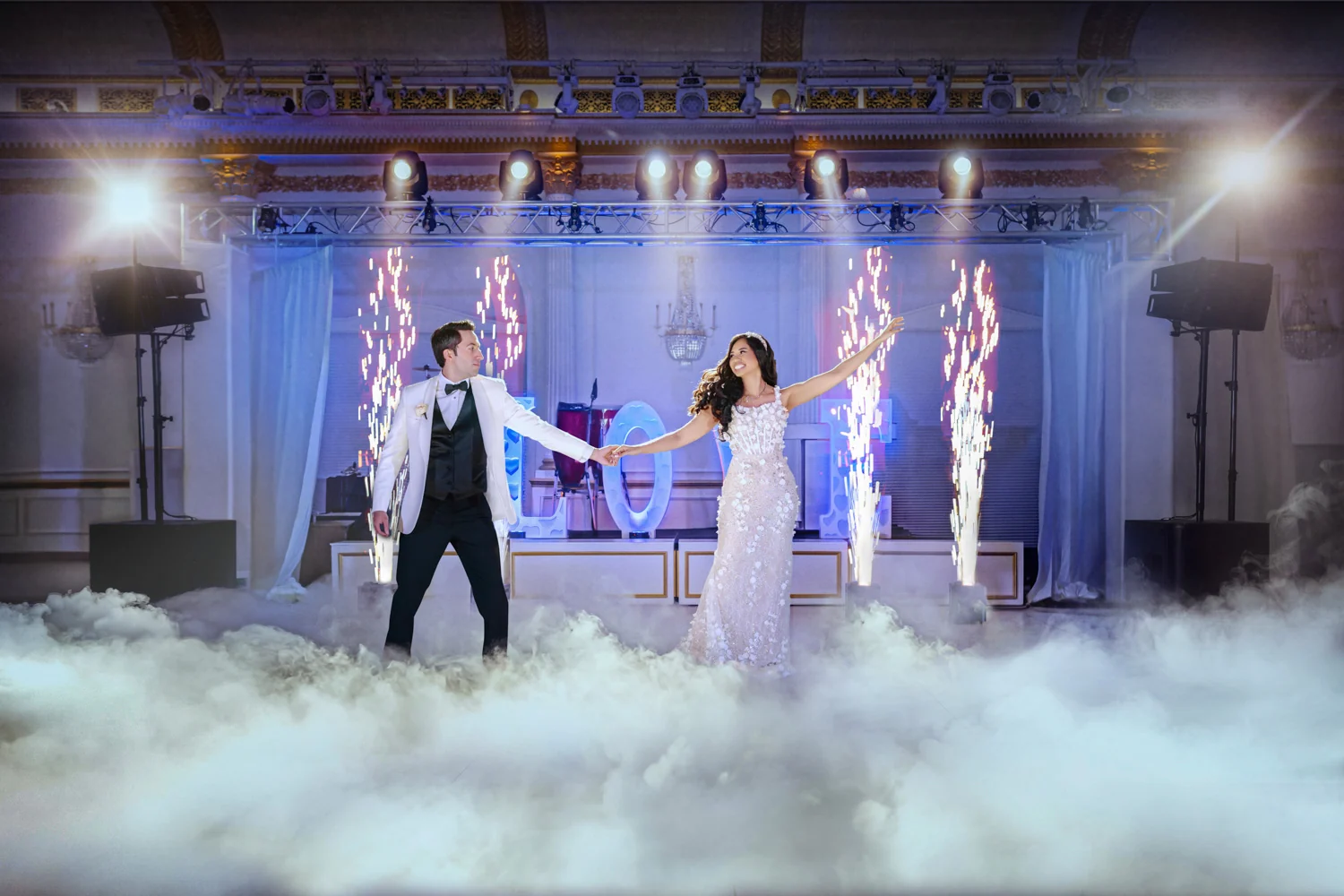
Cold sparks turn a first dance into something cinematic. But there’s one mistake that quietly ruins the photos, and almost every couple makes it.
If you’ve been on Instagram at all during your planning, you’ve seen them: twin fountains of golden sparks arcing up behind a couple mid-first-dance, the whole room glowing. Cold sparks have become one of the most requested reception effects across New Jersey and Long Island, and for good reason. Done well, they produce some of the most dramatic frames of the entire night.
Done without a plan, they produce a beautiful photo of the back of your heads.
What Cold Sparks Actually Are
Despite how they look, cold sparks aren’t traditional pyrotechnics. The machines use a granular metal powder heated electrically to throw a fountain of sparks that cools almost instantly — which is why the effect can run indoors, close to guests, under a ballroom ceiling, in venues that would never permit open flame. The sparks are safe to the touch within inches of the fountain.
That’s what makes them so useful. You get the visual weight of fireworks in the middle of a reception room, without the fire marshal issues that come with the real thing.
The One Mistake: Don’t Look at the Sparks
This is the single most important thing I tell couples, and I’ll say it again on your wedding day right before the song starts.
When the fountains fire, do not turn to look at them. Stay turned toward each other, profiled to the camera. Trust that they’re there.
It’s a completely natural instinct — something spectacular ignites behind you and you want to see it. But the sparks are the backdrop, not the subject. You are the subject. The moment you both turn to watch, I lose your faces, and what should have been a wall-worthy image becomes two silhouettes facing away from the lens.
The couples who nail this are the ones who heard it in advance and made a decision before the music started. Stay in your moment. The sparks will take care of themselves.
Where the Fountains Should Go
Placement changes the photo more than most people expect. A few things I look for:
- Behind you, not beside you — fountains positioned behind the dance floor rim-light your edges and separate you from a dark room. Off to the sides, they mostly light the floor.
- Symmetrical pairs — two or four units evenly spaced frame you. An odd single unit reads as an accident in the corner of the frame.
- Far enough back for depth — sparks close to the lens blow out into white blobs. With a few feet of separation, you get individual streaks of light, which is what makes the image feel three-dimensional.
- Clear of low ceilings and drapery — your venue will have a required clearance. Ask before you book the effect, not the week of.
Talk to Your Venue First
Cold sparks are permitted at most of the ballrooms I shoot across New Jersey and Long Island, but “most” is not “all,” and the rules vary widely. Some venues allow them without comment. Some require a licensed operator and a certificate of insurance. Some require notifying the local fire department. A handful ban them outright, usually because of ceiling height or an older sprinkler system.
Get the answer in writing from your venue before you pay your DJ or entertainment company for the add-on. It is a genuinely deflating conversation to have on the day of.
Pairing Sparks With Low Fog
The two effects are frequently sold together, and they do work beautifully as a pair — the low fog catches and scatters the light from the fountains, so the whole floor glows rather than just the sparks themselves. If you’re doing both, sequence matters: fog first, sparks a few beats later, so the cloud has time to settle across the floor before the light hits it. Your DJ should already know this, but confirm it.
If you’re considering the fog effect on its own, I wrote about it separately in Dancing on the Clouds — there’s a specific detail there that makes or breaks it.
What I’m Doing While They Fire
Cold sparks are a lighting problem as much as a moment. The fountains are extremely bright against a dark reception room, and a camera left on its own will either expose for the sparks and lose your faces to shadow, or expose for you and blow the sparks into a white smear.
My approach is to light you deliberately — off-camera flash positioned so your faces hold detail while the fountains stay as defined streaks rather than a wash. It’s the same lighting thinking I use throughout a reception, which I get into in Off-Camera vs On-Camera Flash. The short version: the sparks are the easy part. Keeping you properly lit in front of them is the part that takes intention.
It also means I need about thirty seconds of warning. Have your DJ or bandleader tell me when the fountains are cued, and I’ll be in position rather than reacting.
Timing Within the Song
Most cold spark units run somewhere between fifteen and forty-five seconds per fill. That is not the whole first dance. So the question becomes when in the song to fire them.
My preference is a moment with some lift — the final chorus, or a dip or spin you’ve planned. Firing at the very first note wastes the effect on a moment where you’re still settling into the dance and possibly still nervous. Firing at the end, on a beat you both know is coming, gives you something to move into.
If you’re doing a choreographed dance, pick the beat now and tell your DJ. If you’re not, pick roughly where in the song and let it be loose.
Other Moments Worth the Sparks
The first dance is the default, but it isn’t the only option. I’ve photographed cold sparks at:
- The grand entrance — high energy, and you’re walking toward the camera, so the “don’t look back” problem solves itself.
- The cake cutting — less common, and surprisingly good, because you’re already turned toward each other.
- The last song of the night — with the whole floor packed around you.
- The exit — if your venue allows it near the doors.
If your package includes a set number of fills, spreading them across two moments usually gives you more than spending them all on one.
If Your Venue Says No
It isn’t the end of the drama. Outdoor sparklers for an exit, an LED or fiber-optic curtain behind the dance floor, uplighting tuned warm, or simply strong off-camera lighting on a dark floor will all produce striking images. Some of the most dramatic first-dance frames in my wedding gallery have no pyrotechnics in them at all. The effect helps. It isn’t what makes the photo.
The Short Version
- Confirm your venue allows cold sparks in writing, early.
- Two or four fountains, behind you, with a few feet of depth.
- Fire them on a moment with lift, not the first note.
- Tell your photographer when they’re cued.
- And when they go off — stay turned toward each other. Don’t look at the sparks.
If you’re planning a wedding across New Jersey, Long Island, or the surrounding area and you want a photographer who knows how to light a reception like this, I’d love to hear about your day.
Frequently Asked
Are cold sparks safe indoors at a wedding venue?
Yes, in most cases. Cold sparks aren’t traditional pyrotechnics — the machines heat a granular metal powder electrically to throw a fountain of sparks that cools almost instantly, which is why they can run indoors, close to guests, and under a ballroom ceiling. That said, “most venues” is not “all venues.” Get written approval from your venue before you pay your DJ or entertainment company for the add-on.
What is the biggest mistake couples make with cold sparks?
Looking at them. When the fountains fire, the instinct is to turn and watch — and the moment you both do, I lose your faces and a wall-worthy image becomes two silhouettes facing away from the lens. The sparks are the backdrop; you are the subject. Stay turned toward each other and trust that they’re there.
Where should the cold spark machines be placed?
Behind you rather than beside you, so the fountains rim-light your edges and separate you from a dark room. Use symmetrical pairs — two or four units evenly spaced — because a single odd unit reads as an accident in the corner of the frame. Leave a few feet of depth so the sparks render as individual streaks instead of blown-out white blobs, and confirm your venue’s required clearance from low ceilings and drapery.
When in the song should the sparks be fired?
Pick a moment with lift — the final chorus, or a dip or spin you’ve planned. Most units run fifteen to forty-five seconds per fill, which is nowhere near a full song, so firing on the very first note wastes the effect while you’re still settling into the dance. If your dance is choreographed, choose the beat now and tell your DJ.
Can cold sparks be used for moments other than the first dance?
Absolutely, and often they should be. The grand entrance works beautifully because you’re walking toward the camera, which solves the “don’t look back” problem entirely. The cake cutting is surprisingly good since you’re already turned toward each other, and the last song or the exit both work well. If your package includes a set number of fills, spreading them across two moments usually gives you more than spending them all on one.
What if my venue doesn’t allow cold sparks?
It isn’t the end of the drama. Outdoor sparklers for an exit, an LED or fiber-optic curtain behind the dance floor, warm uplighting, or simply strong off-camera lighting on a dark floor all produce striking images. Some of the most dramatic first-dance frames in my wedding gallery have no pyrotechnics in them at all — the effect helps, but it isn’t what makes the photo.