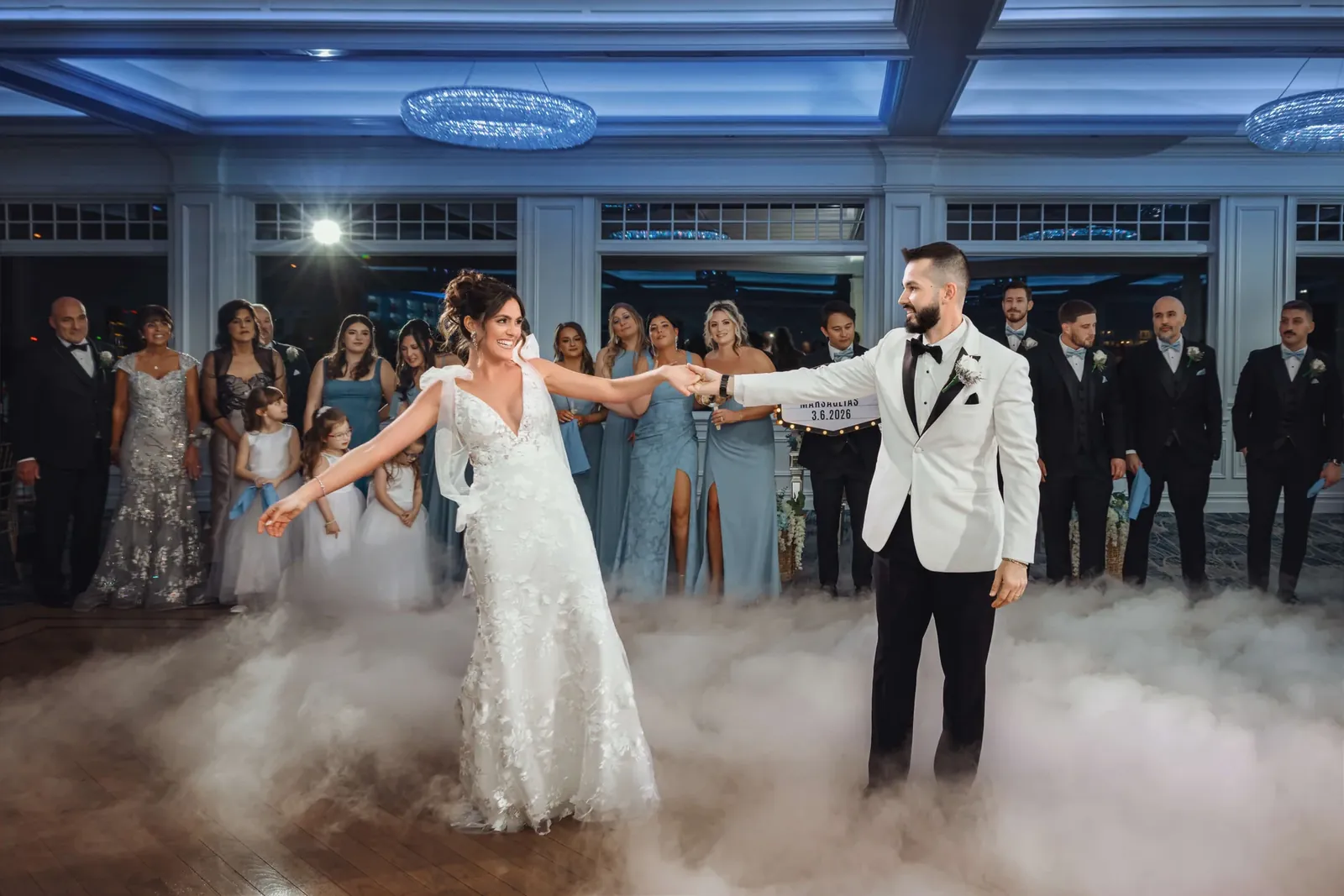
A first dance on a floor of white cloud is one of the most beautiful things I photograph. It also fails more often than any other reception effect — almost always for the same reason.
You’ve seen the effect: the couple steps onto the dance floor and the floor itself disappears into a low, rolling blanket of white. The gown seems to float. Everything below the knee dissolves. It’s called dancing on the clouds, and when it works it produces images that genuinely look like something out of a film.
When it doesn’t work, you get a thin wisp of vapor around your ankles that vanishes before the first chorus, and a line item on your invoice for something nobody in the room actually saw.
Two Machines. Always.
Here is the detail that decides everything:
Make sure your DJ or band runs two low-fog machines at once. One is almost never enough to build a cloud you can actually see — on camera or in the room.
A single machine produces a real cloud for a very short window in a very small footprint. On a hotel or ballroom dance floor in New Jersey or Long Island — which is usually a substantial space — that thin output spreads out, thins further, and is gone. Two machines running simultaneously, positioned on opposite sides of the floor, is what fills the space and gives the cloud enough density to hold for the length of a song.
When a couple tells me the effect didn’t look like the videos, this is the reason virtually every time. It isn’t the venue, the song, or the room. It’s the machine count.
Low Fog Is Not the Same as Fog
Worth being precise, because entertainment companies sometimes aren’t. A standard fog or haze machine fills a room with an even atmospheric haze that hangs in the air — useful for making light beams visible, terrible for this effect. A low-fog machine chills the output so it stays heavy and clings to the floor.
If your DJ quotes you “a fog machine,” confirm they mean a dedicated low-lying fog unit, whether that’s a dry-ice-based machine or a chilled fluid unit. Ordinary hazers will not produce a cloud, and worse, they can leave the whole room hazy for the rest of the night in a way that flattens every subsequent photo.
Dry Ice vs. Chilled Fluid
Both approaches show up at weddings and both work. The differences matter mostly for planning:
- Dry ice produces a very dense, very white cloud that dissipates cleanly and leaves no residue. It requires the vendor to source and store dry ice on the day, and output is finite — when it’s spent, it’s spent.
- Chilled fluid machines can run repeatedly through the night, which is useful if you want the effect for parent dances too. Output is slightly less dense, which makes running two units even more important.
Ask which your vendor uses. Ask how many fills you’re paying for. Ask whether the effect is available again later in the night or is a one-time thing.
The Floor Gets Slippery
This is the practical warning nobody gives couples. Chilled-fluid low fog can leave a faint film on a wood or marble dance floor. Combined with a long gown and dress shoes, it is genuinely slick for the first minute.
Nothing dramatic usually happens, but take the first few steps deliberately rather than sweeping into a spin. If you have a choreographed dance with lifts or fast turns, mention the fog to your instructor and to your DJ, and consider firing the effect after the choreographed section rather than under it.
Ceilings, Vents, and Smoke Detectors
Three venue realities that affect the result:
- HVAC — strong air conditioning blowing across a dance floor will shred a low cloud in seconds. Ask your venue whether the system can be eased down for the first dance. Many will accommodate it.
- Open doors — a propped patio door does the same thing. Worth closing for the duration of the song.
- Detection systems — low fog sits below most detectors and is generally fine, but your venue needs to have signed off. This is a standard question, and any ballroom that does weddings regularly will have a clear answer.
Why It Photographs So Well
Two reasons, and understanding them helps you get more out of the effect.
First, the cloud removes the floor. A reception dance floor is usually the least attractive surface in the room — scuffed wood, gaffer tape, cable runs, the edges of a stage. Erase it and the couple is suddenly floating in negative space, which is exactly what a portrait wants.
Second, the cloud is a reflector. Uplighting, spot lighting, and my own off-camera flash all bounce off the top of the fog and throw soft light back up into your faces and the underside of the gown. You get separation and glow without anything harsh. It’s the same reason cold sparks and low fog pair so well — I wrote about that combination in Cold Sparks, Done Right.
Timing
The cloud needs a moment to settle and spread before it looks like a cloud rather than a jet of vapor. Have your DJ start the machines shortly before you step onto the floor, not on the downbeat. Thirty to sixty seconds of build makes an enormous difference.
And as with any effect, tell me it’s coming. If I know the cloud is building, I’m already low and positioned to shoot across the top of it, which is the angle that makes the gown look like it’s floating. Reacting to it half a song in means missing the densest, best part.
Is It Worth It?
Honestly — yes, if it’s done properly, and no if it isn’t. It is one of the few reception add-ons that meaningfully changes the photographs rather than just the vibe in the room. But a single machine on a large floor is money spent on almost nothing.
So the decision is simple: if your entertainment company will commit to two low-fog units running together, book it. If they’ll only supply one, put the money toward something else and let me light the floor instead. You can see how reception moments look with and without it throughout my wedding gallery.
What to Ask Your DJ
- Is this a dedicated low-lying fog machine, not a hazer?
- How many units will be running at the same time? (You want two.)
- Dry ice or chilled fluid, and how many fills are included?
- Where will they be positioned relative to the dance floor?
- Have you confirmed the effect with my venue?
- Can you start the fog a full minute before we step out?
Planning a wedding in New Jersey or on Long Island? I’m happy to walk through your reception plan with you — get in touch.
Frequently Asked
How many low fog machines do I need for the dancing-on-the-clouds effect?
Two, always. One machine is almost never enough to build a cloud you can actually see — on camera or in the room. A single unit produces a real cloud for a very short window in a very small footprint, and on a typical New Jersey or Long Island ballroom floor that output spreads, thins, and is gone. Two machines running simultaneously on opposite sides of the floor is what fills the space.
Is a fog machine the same as a low fog machine?
No, and the distinction matters. A standard fog or haze machine fills a room with an even atmospheric haze that hangs in the air — useful for making light beams visible, terrible for this effect. A low-fog machine chills the output so it stays heavy and clings to the floor. If your DJ quotes you “a fog machine,” confirm they mean a dedicated low-lying unit; an ordinary hazer can leave the whole room hazy and flatten every photo for the rest of the night.
What is the difference between dry ice and chilled fluid low fog?
Both work. Dry ice produces a very dense, very white cloud that dissipates cleanly and leaves no residue, but the vendor has to source and store it on the day, and output is finite — when it’s spent, it’s spent. Chilled fluid machines can run repeatedly through the night, which is useful if you want the effect for parent dances too, though the output is slightly less dense, which makes running two units even more important.
Does low fog make the dance floor slippery?
It can. Chilled-fluid low fog leaves a faint film on a wood or marble dance floor, and combined with a long gown and dress shoes, it’s genuinely slick for the first minute. Nothing dramatic usually happens, but take your first few steps deliberately rather than sweeping into a spin. If your dance is choreographed with lifts or fast turns, mention the fog to your instructor and consider firing the effect after the choreographed section.
Can air conditioning ruin the low fog effect?
Yes, quickly. Strong air conditioning blowing across a dance floor will shred a low cloud in seconds, and a propped patio door does the same thing. Ask your venue whether the HVAC can be eased down for the first dance — many will accommodate it — and close exterior doors for the duration of the song.
How far in advance should the fog start before we step onto the floor?
Thirty to sixty seconds. The cloud needs a moment to settle and spread before it looks like a cloud rather than a jet of vapor, so have your DJ start the machines shortly before you step out, not on the downbeat. And tell me it’s coming — if I know the cloud is building, I’m already low and positioned to shoot across the top of it, which is the angle that makes the gown look like it’s floating.