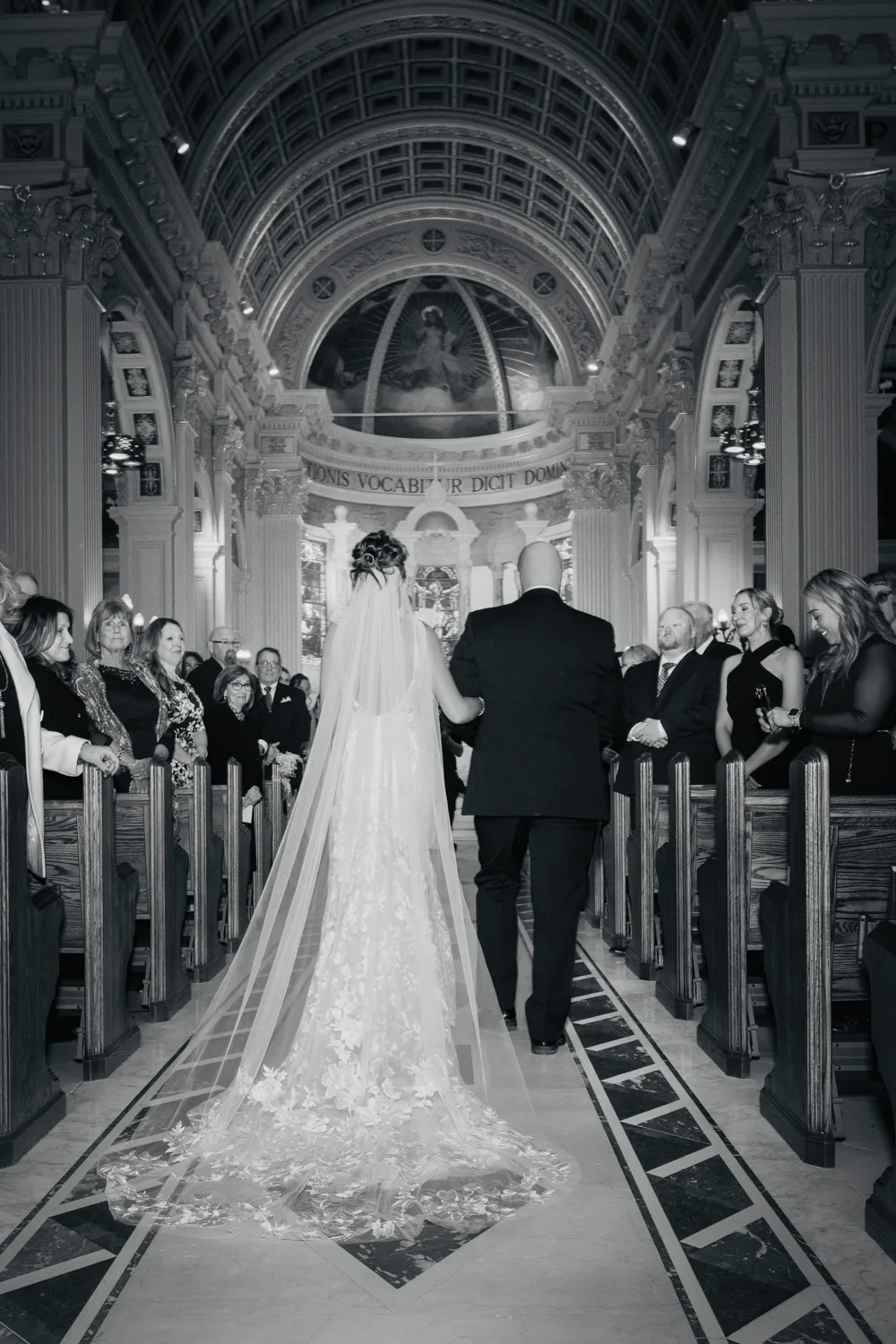
The ceremony ends, and within ten minutes someone is turning off the lights. This is the single most overlooked hour in a church wedding timeline.
If you’re getting married in a church — and across New Jersey, Staten Island, and Long Island, a large share of my couples are — there’s a piece of the timeline that almost nobody accounts for until it’s too late.
You assume that once the ceremony ends, the church is still yours for a while. In many parishes it isn’t. The recessional finishes, the guests file out, and a sacristan starts switching off the sanctuary lights and moving toward the doors. Sometimes there’s another Mass, another wedding, or a confession schedule right behind you. Sometimes it’s simply the parish’s policy.
And everything you assumed you’d photograph in that building — gone.
What That Hour Actually Holds
Booking an extra hour after the ceremony is not a luxury. Look at what has to happen in it:
- Your grand exit from the church. Bubbles, petals, bells, or just the doors opening onto the steps. It needs guests still present and staged, which takes a few minutes to organize.
- Immediate family photos. Parents, siblings, grandparents. The church is where every one of these people is standing right now — and it is the last moment all day when that will be true.
- Bridal party portraits. Same logic. Everyone is assembled, dressed, and in one place.
- Portraits of the two of you at the altar, in the aisle, on the steps, and outside the facade.
That is not a fifteen-minute list. Compressed into the ten minutes before somebody starts locking up, it becomes a frantic scramble, and the photographs show it.
My Honest Advice: Skip the Greeting Line
Before anything else in this timeline, let me recommend against the one thing that most reliably destroys it.
I recommend skipping the greeting line after your church ceremony. It is the easiest way to burn twenty minutes off an already tight schedule — and you are going to see every one of these people at the reception anyway.
This isn’t a theoretical position. Across all of my church weddings in the past year, 100% of my couples skipped the greeting line after the ceremony. Not one of them regretted it, and not one of them told me a guest was offended.
The math is unforgiving. A church with 150 guests and a line at the back moves at roughly ten seconds a person once you account for hugs, congratulations, photos, and the aunt who wants to talk. That’s twenty-five minutes, minimum — and it comes straight out of the hour you just fought to reserve. Meanwhile the light outside is changing, your family is drifting to the parking lot, and the sacristan is checking a watch.
You will greet these people at cocktail hour. You will greet them again during dinner. Many of them you’ll dance with. A greeting line at the church duplicates something that’s already going to happen, at the exact moment it costs you the most.
Use those twenty-five minutes on the family photographs and altar portraits instead. Those are the things you cannot get later.
The Altar Shot You Only Get Here
Worth singling out. A wide frame of the two of you alone at the altar of an empty church — the vaulting above you, the stained glass, the aisle stretching back — is one of the most striking images from any wedding day. It is also completely impossible to make anywhere else. Your reception venue does not have a fifty-foot nave.
It takes maybe five minutes. It requires the lights to still be on and the church to still be open. Couples who didn’t reserve the time almost never get it, and they always notice its absence later.
Why Churches Move So Fast
It’s not unfriendliness. Parishes run tight schedules, especially on a Saturday. A church that hosts three weddings in an afternoon has to turn the space over. Volunteer staff have somewhere to be. Heating and lighting cost money. And most parishes simply assume that when the wedding party leaves, the wedding is over.
Nobody tells you this during your pre-Cana meetings, because from the church’s side it isn’t a photography question — it’s a facilities question.
How to Reserve It
The conversation is straightforward, and it should happen when you book the church, not the month before:
“After the ceremony ends, how long do we have in the church for family photographs and portraits? Is there anything scheduled behind us? Can we reserve an additional hour, and is there a fee?”
Some parishes will simply say yes at no cost. Some charge a modest additional donation. Some genuinely cannot accommodate it because of what’s scheduled after you, in which case you’ve learned something crucial early enough to plan around it — by doing a first look, moving family photos to the venue, or shortening your receiving line.
Get the answer in writing along with the rest of your church requirements. While you’re at it, ask about photography restrictions during the liturgy itself — where I’m permitted to stand, whether flash is allowed, and whether the parish has a policy on guest photography. That last one pairs naturally with an unplugged ceremony.
How It Changes the Rest of Your Day
This is the part couples don’t anticipate: reserving that hour usually makes the whole afternoon calmer, not tighter.
If family and bridal party photos are done at the church, they aren’t eating your cocktail hour. You arrive at the reception venue with the formal list already complete, which means the time there goes to portraits of the two of you in good light — or to actually attending your own cocktail hour, which more couples should do.
The alternative is the familiar one: a long greeting line, a rushed exit from the church, a stressed drive, and then forty-five minutes of grandparents being rounded up in a hotel lobby while the cocktail hour you paid for happens without you.
Where This Fits in Your Coverage
An hour at the church is a real hour of photography coverage, and it’s one of the reasons church weddings without a first look generally need more total hours than venue-only weddings. Hotel prep, a church ceremony, and a separate reception venue is an extremely common New Jersey and Long Island pattern, and it typically calls for ten to twelve hours.
I laid out how to think through that decision, with a real sample timeline built around a church ceremony, in How Many Hours of Coverage Do I Need?
A Quick Checklist
- Ask the parish how long you have after the ceremony — before you sign anything.
- Reserve an additional hour if it’s available.
- Skip the greeting line. You’ll see everyone at the reception.
- Confirm whether another Mass or wedding follows you.
- Build a tight family photo list — seven or eight groupings, not thirty — and name one person from each family to round people up.
- Ask your officiant to announce that immediate family should stay seated after the recessional.
- Confirm photography rules for the ceremony itself.
- Tell your transportation company the new departure time.
That fifth point is quietly the most valuable one on the list. Guests scatter within ninety seconds of the recessional. An announcement keeps the people you need in the building.
Worth the Ask
An extra hour after your ceremony is one of the cheapest and highest-return decisions in a church wedding. It protects your family portraits, your altar photographs, your exit, and your cocktail hour all at once — and it costs, at most, a small additional donation and one phone call. Reserve the hour, skip the greeting line, and spend the time on the photographs you can only make inside that building.
You can see church wedding work throughout my wedding gallery. If you’re planning a wedding in New Jersey, on Long Island, or in Staten Island, I’d love to help you build a timeline that holds — get in touch.
Frequently Asked
Should we do a greeting line after our church ceremony?
I recommend against it. A greeting line is the easiest way to burn twenty minutes off an already tight schedule, and you are going to see every one of these people at the reception anyway. Across all of my church weddings in the past year, 100% of my couples skipped the greeting line after the ceremony — and none of them regretted it. Spend those minutes on family photographs and altar portraits instead, because those are the things you cannot get later.
Should I book extra time at the church after the ceremony?
Yes. Reserve roughly an additional hour whenever the parish allows it. Many churches begin switching off lights and closing doors within minutes of the recessional, and without reserved time your family photos, bridal party portraits, altar images, and grand exit have nowhere to happen.
How long do churches stay open after a wedding ceremony?
It varies widely, and often far less time than couples expect. Parishes run tight Saturday schedules, and another Mass, wedding, or confession slot may follow immediately. Ask the parish directly when you book the church rather than assuming the space stays yours.
What happens during that extra hour at the church?
The grand exit from the church, immediate family photographs, bridal party portraits, and portraits of the two of you at the altar, in the aisle, on the steps, and outside the facade. The church is the last moment all day when every one of those family members will be standing in one place.
Can we take photos at the altar after the ceremony?
Yes, provided the church is still open and lit. A wide frame of the two of you alone at the altar of an empty church is impossible to recreate anywhere else, and it takes about five minutes. Couples who did not reserve the time almost never get it.
Does a church wedding need more photography coverage?
Usually, yes. Hotel prep, a church ceremony, and a separate reception venue is a common New Jersey and Long Island pattern that typically calls for 10 to 12 hours, especially without a first look. Travel, parking, and the post-ceremony hour all add real time.