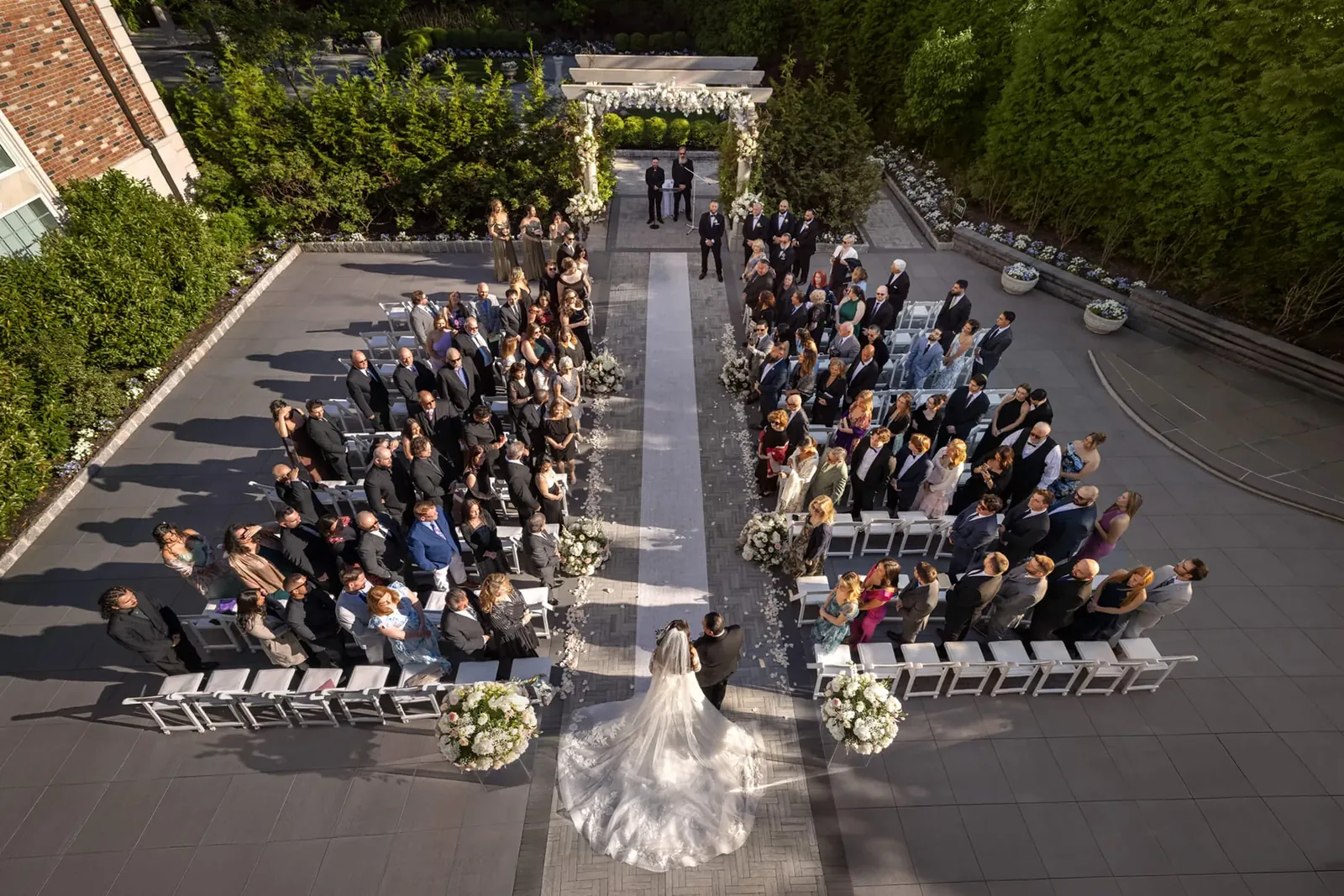
There is nothing worse than a phone in the aisle blocking your first kiss. It is entirely preventable, and it takes one sentence from your officiant.
Here is a photograph I have watched get destroyed more times than I can count.
The ceremony reaches its moment. The officiant says the line. And as the two of you lean in, a guest in the third row leans out into the aisle with a phone held at arm’s length, or an aunt stands up with an iPad, and the frame that should have been the centerpiece of your album now has a glowing rectangle and a stranger’s forearm in the middle of it.
I can work around a lot. I cannot move a person out of the aisle in the half second your first kiss lasts.
What an Unplugged Ceremony Is
Simply: you ask your guests to put their phones and cameras away for the duration of the ceremony. Not the whole wedding — the cocktail hour and reception are fair game, and honestly the guest photos from the dance floor are often great. Just the ceremony, the twenty to forty minutes that matter most and that cannot be repeated.
It has become far more common over the last several years, and in my experience guests almost never object. Most of them are relieved. Nobody actually enjoys watching a wedding through a four-inch screen.
What You Get Back
- A clear aisle. Your processional and recessional are photographed as they were designed — two rows of faces turned toward you, not a gauntlet of raised arms.
- An unobstructed first kiss. The single most predictable, least repeatable frame of the day.
- Faces instead of devices. Your guests’ real reactions are some of my favorite images from any ceremony. Phones hide them.
- Guests who were actually there. This is the part couples mention afterward more than the photographs.
- No competing flashes. A guest phone flash firing mid-vow can genuinely affect the exposure of a frame I only get once.
How to Ask
The request works best when it comes from multiple directions and none of them feel scolding.
Your officiant, out loud, right before you walk. This is the one that actually works. A short, warm line delivered to a seated room, thirty seconds before the processional:
“Before we begin — the couple has asked that this be an unplugged ceremony. Please put your phones and cameras away and be fully present with them. Their photographer will capture everything, and they’ll share the photos with you.”
A sign at the entrance. Handsome, on an easel, in your palette. Sets the expectation before anyone sits down.
A line in the program or on your wedding website, if you have them.
Your ushers, quietly, as they seat people. Optional, but effective for the front rows — which are the rows that matter most.
Notice the framing in all of these: be present with us, and we’ll share the photos. That second half matters. Guests take photos because they want a keepsake. Promising them yours removes the reason.
Churches Often Have Their Own Rules
If you’re marrying in a church — and across New Jersey, Staten Island, and Long Island a great many of my couples are — there may already be a policy, and it may be stricter than yours. Some parishes prohibit guest photography outright, restrict where any photographer can stand, or ask that no one leave their pew during the liturgy.
Find out early. It affects my coverage plan as much as your guests’ behavior, and it is much better handled in a phone call weeks out than in a whispered conversation with a deacon five minutes before the processional. While you’re speaking with the parish, it’s also worth asking about your time in the church after the ceremony ends — that’s a separate conversation that catches a lot of couples off guard.
The Reasonable Exceptions
You don’t have to be absolute about it. Some couples make an exception for a grandparent who genuinely wants a photo, or ask a specific family member to take a few from a seated position without leaning out. Some couples run unplugged only until the kiss, then invite everyone to shoot the recessional — which is actually a lovely moment, phones and all, because you’re walking toward a room full of people cheering.
The part that isn’t negotiable, if you care about the pictures, is the aisle during the processional and the kiss.
Now: Don’t Rush the Kiss
Having protected the shot, here’s how to make sure there’s something in it.
When the moment comes, pause, hold it, and stay there a beat longer than feels natural. A quick peck is a blur. A held kiss is a frame you’ll hang on your wall.
Nearly everyone rushes it. You’re nervous, the room is watching, you’ve been waiting the entire day for this and the instinct is to touch and separate. From where I’m standing, that reads as motion blur and two half-turned faces.
Two or three seconds is all I need. It feels like ten when you’re in it. It looks like a photograph when you’re out of it.
A Few More Seconds of Advice
- Turn slightly toward the guests as you kiss rather than staying squared off to each other. It opens both of your faces to the room and to the lens.
- Free hand matters — on a cheek, on a waist, or holding a bouquet down and out of the way. A bouquet held up at chest height covers both of you.
- Bouquet down during the processional and the kiss. Held low, at the hip. It is the most common thing I correct.
- Then pause again before you walk. A half second of looking at each other before the recessional is often better than the kiss itself.
Worth the One Sentence
An unplugged ceremony costs you nothing, takes thirty seconds to arrange, and protects the handful of frames from your wedding day that genuinely cannot be recreated. Combined with a kiss you actually hold, it is the difference between a ceremony gallery you scroll past and one you print.
You can see ceremony work throughout my wedding gallery. If you’re planning a wedding in New Jersey, on Long Island, or in Staten Island, I’d love to hear about your day.
Frequently Asked
What is an unplugged ceremony?
You ask your guests to put their phones and cameras away for the duration of the ceremony — not the whole wedding. Cocktail hour and the reception are fair game, and honestly the guest photos from the dance floor are often great. Just the ceremony: the twenty to forty minutes that matter most and that cannot be repeated.
How do I ask guests for an unplugged ceremony?
The request works best from multiple directions, and none of them should feel scolding. The one that actually works is your officiant, out loud, thirty seconds before the processional: “Before we begin — the couple has asked that this be an unplugged ceremony. Please put your phones and cameras away and be fully present with them. Their photographer will capture everything, and they’ll share the photos with you.” Add a sign at the entrance, a line in the program or on your website, and have your ushers mention it quietly as they seat the front rows.
Why does a phone in the aisle ruin the first kiss photo?
Because a photographer cannot move a person out of the aisle in the half second a first kiss lasts. When a guest in the third row leans out with a phone at arm’s length, or an aunt stands up with an iPad, the frame that should have been the centerpiece of your album has a glowing rectangle and a stranger’s forearm in the middle of it. It’s the single most predictable, least repeatable frame of the day.
What do we actually gain from an unplugged ceremony?
A clear aisle, so your processional and recessional are photographed as they were designed — two rows of faces turned toward you rather than a gauntlet of raised arms. An unobstructed first kiss. Faces instead of devices, since your guests’ real reactions are some of my favorite images from any ceremony. No competing flashes, which can genuinely affect the exposure of a frame I only get once. And guests who were actually there — that’s the part couples mention afterward more than the photographs.
Do churches have their own photography rules?
Frequently, and they may be stricter than yours. Across New Jersey, Staten Island, and Long Island, many parishes prohibit guest photography outright, restrict where any photographer can stand, or ask that no one leave their pew during the liturgy. Find out early — it affects my coverage plan as much as your guests’ behavior, and it’s much better handled in a phone call weeks out than in a whispered conversation with a deacon five minutes before the processional.
How long should we hold the first kiss?
Two or three seconds. Nearly everyone rushes it — you’re nervous, the room is watching, and the instinct is to touch and separate. From where I’m standing, that reads as motion blur and two half-turned faces. It feels like ten seconds when you’re in it, and it looks like a photograph when you’re out of it. Turn slightly toward the guests as you kiss rather than staying squared off, keep the bouquet held low at the hip, and pause again before you walk.