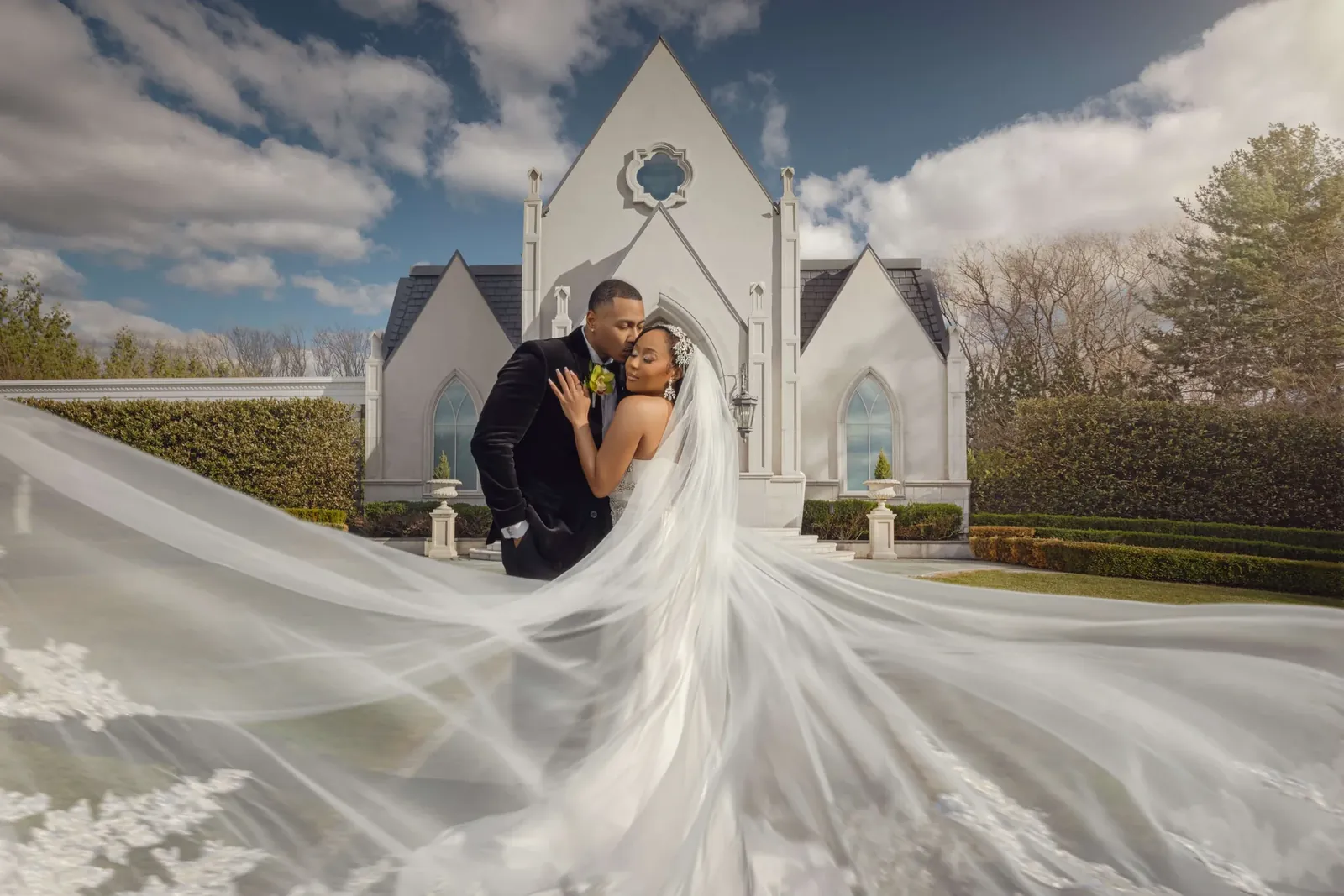
After nearly two decades of photographing weddings, George has learned that the veil you choose decides which portraits are possible. Some veils catch the wind, float, and frame a couple beautifully. Others hang flat, hide your face, or fight the camera. This guide explains what to look for, and why each choice changes your photos.
The Magic of a Long Veil
If there’s one thing we’ll tell every bride, it’s this: long veils are a game-changer for portraits. The reason is simple. More fabric gives the wind more to lift and gives George more to work with: a veil thrown into the air for a wide, dramatic frame, a sweeping horizontal line across the image, or enough length to drape over both of you for an intimate portrait under the veil. A shorter veil frames your face nicely, but there isn’t enough of it to create those shapes.
Around 99% of the brides we work with end up choosing a Royal or Cathedral-length veil, once they see what it does in camera, it’s an easy decision. And if you’re worried about wearing a long veil all night, you can always remove it after the ceremony and portraits.
For a dedicated portrait session in your gown before or after the wedding, see our guide to a creative bridal shoot.
The Veil Portraits We Plan For
Most of George’s veil portraits fall into a few looks, and each one asks something different of the veil:
- The veil toss: the veil is thrown and caught mid-air in a wide portrait that shows your surroundings. It needs length and a light fabric that opens up instead of dropping straight down.
- The sweep: the veil flows in a long horizontal line across the frame. It needs length and a soft fabric that ripples rather than holding a stiff shape.
- Under the veil: the veil drapes over both of you for a close, private portrait. It needs to be long enough to cover two people and sheer enough that your faces read clearly through it.
- The framing layer: the veil sits in the foreground or wraps around you to soften the edges of the frame. This works with almost any veil, but sheer fabric and a delicate edge look best.
You can see veil portraits throughout our wedding gallery.
Choosing the Right Veil for Photos
Any veil can enhance your look, but a few details make the difference between a veil that photographs beautifully and one that doesn’t:
- Length: cathedral-length or longer gives enough fabric for tosses, sweeps, and under-the-veil portraits. Fingertip and shorter veils are lovely for framing your face, but they can’t create those larger shapes. (It’s why nearly all of our brides choose Royal or Cathedral.)
- Fabric: soft, fine tulle moves and floats in a breeze. Stiff netting holds its shape, so it tends to puff out instead of flowing, and it looks rigid in motion shots.
- Sheerness: a sheer veil lets light pass through and keeps your faces visible in under-the-veil and framing shots. A dense or heavily layered veil turns into a solid white wall in front of the lens.
- Fullness: a wider, single-layer veil fills more of the frame when it’s thrown or caught by the wind. Extra layers add volume at your head and weight overall, so the veil lifts less easily.
- Embellishments: a subtle pattern or lace edge gives the light something to catch and adds texture even in a still frame. Heavy beading or lace across the whole veil adds weight, so it falls instead of floating, and can snag on your hair or dress. Keeping detail along the edge keeps the rest of the veil light.
Before you buy: if you can, hold the veil up and let it fall, or ask the shop to show you how it moves. If it drops quickly and hangs straight, it will do the same in the wind.
Wind, Placement & Your Hairstylist
Wind is what makes outdoor veil portraits come alive, and it’s also what can tangle a veil or blow it across your face. A light, steady breeze is ideal. On a gusty day, George positions you relative to the wind so the veil carries away from your face, and frames that need calm air can be saved for a sheltered spot or indoors, where the veil becomes a framing layer instead.
How the veil is attached matters just as much as the veil itself, so plan it with your hairstylist:
- Bring the veil to your hair trial so your stylist can design the style around where the comb sits.
- Choose the placement with photos in mind: a comb set at the crown or just below an updo lets the veil fall cleanly behind you and lift without pulling on your hair.
- Secure it firmly so it stays put when the veil is tossed or caught by the wind, but can still come out and go back in without redoing your hair.
- Keep hair off your face: talk to your stylist about a part and style that keep your face clear, especially at the altar.
- Choose a helper: have your stylist show a bridesmaid or family member how to take the veil out and put it back in, in case you remove it after the ceremony and want it back for portraits.
Let’s Plan Your Veil Portraits
The right veil, attached the right way, gives you portraits that feel elegant, romantic, and entirely yours. Tell George about your veil’s length, fabric, and how it will be attached before the wedding, and he can plan which veil portraits fit your day, your venue, and your timeline.
Planning a wedding across New Jersey or Long Island? We’d love to bring your vision to life.
Frequently Asked
What length veil is best for wedding photos?
Cathedral length or longer. The added fabric allows for wide, sweeping shots and room to play with movement, which is where the drama comes from. Around 99% of the brides we work with end up choosing a Royal or Cathedral-length veil, once they see what it does in camera, it’s an easy decision.
Why do photographers love long veils so much?
Because a veil isn’t just an accessory: it’s an artistic tool. A flowing, cathedral-length veil adds drama, movement, and sophistication. The real magic is how it moves with the wind, creating that fairytale moment that makes a shot look like it came straight out of a film.
It also connects you to your surroundings: a bride framed against an elegant estate with her veil sweeping in the wind, or a veil draped around a couple’s faces creating a private, dreamy world. Used as a storytelling element, the veil flows, wraps, and frames, turning each image into a piece of art.
Should I talk to my photographer about my veil before the wedding?
Yes, please. We love collaborating with brides ahead of the day to experiment with veil styles and poses, so everything is dialed in by the time we shoot. Knowing your veil length, fabric, and how it’s attached lets George plan which shots are possible. That’s particularly true for the movement frames, where he might be tossing it into the air or using it to frame a close-up of your face.
Can veil portraits work indoors or only outside?
Both, though they work differently. Outdoors, wind is the collaborator: that’s where the sweeping, wind-blown frames come from.
Indoors, the veil becomes a framing device: draped around your faces for an intimate close-up, or layered to add depth and softness. Either way the veil adds layers to the story, from dreamy black-and-white frames to vibrant, colorful imagery. You can see veil portraits throughout our wedding gallery.
Does the veil fabric or pattern matter?
It does. Length and fabric make the biggest difference for dramatic portraits, and a veil with a subtle pattern or lace edge brings extra dimension to the images. A plain tulle veil moves beautifully but reads as simple; a patterned or lace-edged one gives light something to catch, which adds texture even in a still frame. Both can work well, and the choice should reflect your overall bridal look.
If you’re planning a wedding across New Jersey or Long Island and want a photographer who knows how to use a veil, we’d love to bring your vision to life.